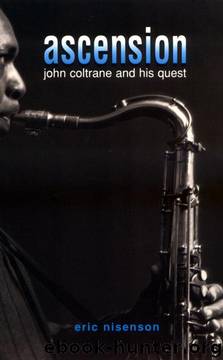
Ascension: John Coltrane And His Quest by Eric Nisenson
Author:Eric Nisenson
Language: eng
Format: epub
Published: 2009-05-15T06:25:00+00:00
Coltrane was now recognized by anyone even vaguely aware of jazz as the single most important jazz musician of his time, even more so than Ornette Coleman. He won every poll on both tenor and soprano saxophone, and his group routinely dominated the polls, with Elvin and McCoy becoming increasingly important figures themselves. Miles Davis was in 1964 almost considered a relic of the past. Until 1963 Miles was still basically playing postbop with pretty much the same repertory of tunes, except for the addition of a couple of modal pieces. His former sideman John Coltrane was overshadowing him now, and Miles knew it.
Miles, incidentally, had a theory about the New Thing: It was all the fault of a sort of conspiracy among racist white critics. In his Autobiography, he writes, "I think some of pushing the free thing among a lot of the white music critics was intentional, because a lot of them thought that people like me were just getting too popular and powerful in the music industry. They had to find a way to clip my wings."
Of course, Miles's basic premise is ludicrous: many, if not most, critics, almost all of them white, abhorred the so-called "free jazz" and certainly were not reticent to put their opinions in print. Actually, probably the two most avid supporters of the "New Thing" were Amiri Baraka (then LeRoi Jones) and A. B. Spellman, both black.
In 1964 Coltrane released two albums that summed up all his work with the quartet up to that time. The first, titled Crescent, was recorded in spring of that year. For a variety of reasons, this became the favorite album of critics like Martin Williams and Whitney Balliet who rarely found favor for Coltrane's work. One of his most accessible albums, it is beautiful, at times stunningly so. Coltrane does not improvise on the only piece that runs over ten minutes, and the blues on the album, the sort of thing that Coltrane would play for a half hour or more in a club, is only three and a half minutes long. The album has a haunting air of contemplation and dark-hued lyricism. Coltrane seems to be compressing many of his ideas and musical avenues, particularly lyrical modalism, expressed on earlier albums. Crescent is further proof for those that needed it that he could play with taut cohesion and discipline when he wanted to.
Crescent is a unified work only in terms of mood. There is no question, however, about the concept of A Love Supreme, the album that was recorded a few months later, in December 1964. This work was conceived as a whole in one night, and it became Coltrane's most popular, if not his greatest, album. What can be said about an album that has been so widely discussed and analyzed? It is one of the few jazz records that is often owned by people with only -a general interest in jazz.
A Love Supreme has been described as a prayer, a work of devotion, a meditation on God, but it is much more than that.
Download
This site does not store any files on its server. We only index and link to content provided by other sites. Please contact the content providers to delete copyright contents if any and email us, we'll remove relevant links or contents immediately.
The Goal (Off-Campus #4) by Elle Kennedy(13783)
Kathy Andrews Collection by Kathy Andrews(11981)
Diary of a Player by Brad Paisley(7653)
Assassin’s Fate by Robin Hobb(6298)
What Does This Button Do? by Bruce Dickinson(6263)
Big Little Lies by Liane Moriarty(5881)
Altered Sensations by David Pantalony(5156)
Pale Blue Dot by Carl Sagan(5083)
Sticky Fingers by Joe Hagan(4256)
The Death of the Heart by Elizabeth Bowen(3677)
The Heroin Diaries by Nikki Sixx(3613)
Confessions of a Video Vixen by Karrine Steffans(3353)
Beneath These Shadows by Meghan March(3342)
How Music Works by David Byrne(3330)
Computational Linguistics and Intelligent Text Processing: 20th International Conference, CICLing 2019 La Rochelle, France, April 7â13, 2019 Revised Selected Papers, Part I by Alexander Gelbukh(3246)
The Help by Kathryn Stockett(3192)
Jam by Jam (epub)(3157)
Harry Potter 4 - Harry Potter and The Goblet of Fire by J.K.Rowling(3134)
Strange Fascination: David Bowie: The Definitive Story by David Buckley(2913)
